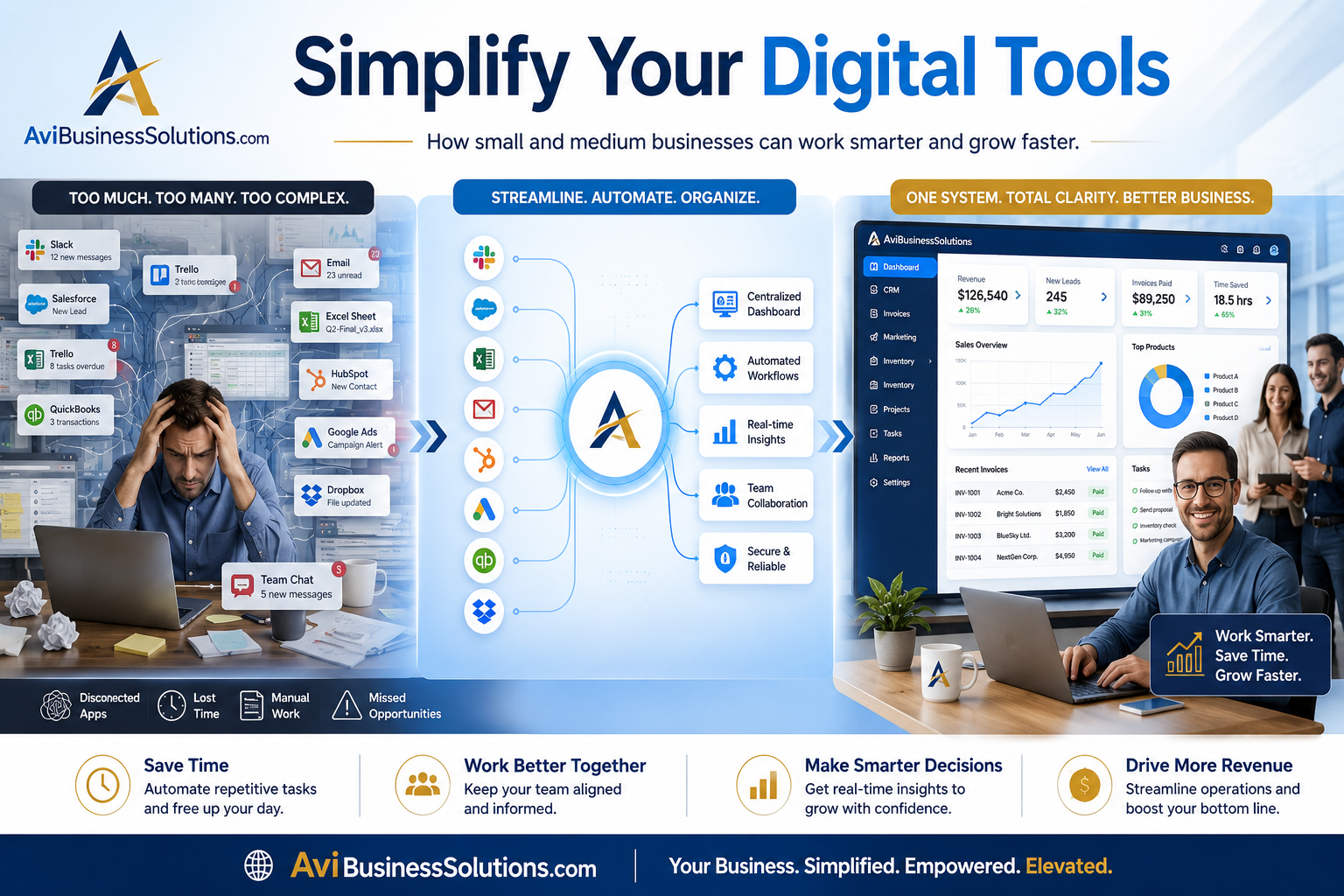
By the team at AviBusinessSolutions.com
Small and medium-sized businesses today face a tough environment. With more competition, fast-changing technology, and growing expectations for social and environmental responsibility, it’s easy for business owners and managers to feel overwhelmed. Many try to keep up by adding new computer programs and online services, but this approach can cause problems if not handled thoughtfully.
The Problem with Too Many Tools
It might seem that the more computer programs and online services you have, the better your business will run. But research shows the opposite can happen. When companies use too many different types of software—especially ones that don’t work well together—employees end up wasting time on repetitive, manual tasks. Instead of making things easier, complicated systems slow teams down and make it harder to keep up with the competition.
The Power of Practical Housekeeping
Instead of always adding more programs, successful businesses take a "housekeeping" approach: they regularly review which computer programs or services are actually useful and remove those that aren’t. This simple step can make a big difference. By removing unused or duplicate software, companies free up time, cut costs, and help their teams focus on work that matters—like serving customers or generating new ideas.
Better for Business—and the Planet
Cleaning up your computer systems isn’t just about saving time and money. It also helps businesses become more sustainable. Using fewer, more effective programs and services can mean less energy and paper wasted and help companies meet growing expectations for environmental responsibility.
How to Get Started
Here are a few steps any business can take:
- Review Your Technology: List all the computer programs and online services your business uses. Identify which ones are actually helping and which ones are rarely used or create extra work.
- Simplify and Connect: Consider switching to platforms that let different tools work together. The goal is to reduce the number of separate systems your team has to juggle.
- Invest in Training: Make sure your team knows how to use the chosen tools effectively. Good training boosts productivity and makes change easier.
- Ask for Help if Needed: Governments and business support organizations often have programs to help small businesses modernize their digital operations. Look for grants or advisory services that could make the transition smoother.
- Keep Reviewing: Technology changes quickly, so make digital housekeeping a regular habit. Review your tools every year to ensure they still meet your needs.
The Bottom Line
You don’t need the latest, most expensive technology to succeed. By focusing on practical steps—like cleaning up your digital tools—you can make your business faster, more efficient, and better prepared for the future. In today’s competitive world, a simpler approach often leads to the best results.
References
Aboelmaged, M. (2018). The drivers of sustainable manufacturing practices in Egyptian SMEs and their impact on competitive capabilities: A PLS-SEM model. Journal of Cleaner Production. https://doi.org/10.1016/j.jclepro.2017.12.053
Ameen, N., Choudrie, J., & Jones, P. (2022). Innovative technologies and small-to medium-sized enterprises in times of crisis. Information Systems Frontiers. https://doi.org/10.1007/s10796-022-10353-7
Chege, S. M., & Wang, D. (2020). The influence of technology innovation on SME performance through environmental sustainability practices in Kenya. Technology in Society. https://doi.org/10.1016/j.techsoc.2019.101210
El-Haddadeh, R. (2020). Digital innovation dynamics' influence on organizational adoption: The case of cloud computing services. Information Systems Frontiers. https://doi.org/10.1007/s10796-019-09912-2
Isensee, C., Teuteberg, F., Griese, K. M., & Topi, C. (2020). The relationship between organizational culture, sustainability, and digitalization in SMEs: A systematic review. Journal of Cleaner Production. https://doi.org/10.1016/j.jclepro.2020.122944
Khan, S. A. R., Godil, D. I., Jabbour, C. J. C., Shujaat, S., Razzaq, A., & Yu, Z. (2021). Green data analytics, blockchain technology for sustainable development, and sustainable supply chain practices: Evidence from small and medium enterprises. Annals of Operations Research. https://doi.org/10.1007/s10479-021-04275-x
Prasanna, R. P. I. R., Jayasundara, J. M. S. B., Naradda Gamage, S. K., Ekanayake, E. M. S., Rajapakshe, P. S. K., & Abeyrathne, G. A. K. N. J. (2019). Sustainability of SMEs in the competition: A systematic review on technological challenges and SME performance. Journal of Open Innovation: Technology, Market, and Complexity, 5(4), 100. https://doi.org/10.3390/joitmc5040100
Saunila, M., Rantala, T., Ukko, J., & Havukainen, J. (2019). Why invest in green technologies? Sustainability engagement among small businesses. Technology Analysis & Strategic Management, 31(6), 653–666. https://doi.org/10.1080/09537325.2018.1542671
Sharma, M., Raut, R. D., Sehrawat, R., & Ishizaka, A. (2023). Digitalization of manufacturing operations: The influential role of organizational, social, environmental, and technological impediments. Expert Systems with Applications, 196, 116919. https://doi.org/10.1016/j.eswa.2022.118501